Articles are small but powerful words in English grammar. They help identify nouns as specific or general. Understanding article rules is essential for speaking and writing English fluently. This post explains articles a, an, and the rules with examples of articles in sentences.
In this detailed guide, you’ll learn the types of articles, how to use them correctly, and the most important rules of articles. By the end, you’ll have full clarity about when to use a, an, or the in your writing.
What an Article?
Articles are words placed before nouns to show whether the noun is specific or general. They help make communication clear and precise.
Examples:
- A cat is on the wall. (any cat)
- The cat is sleeping on the bed. (a specific cat)
Articles, like a and the, belong to a group called determiners, which indicate whether a noun is known or unknown.
Types of Articles
In English grammar, articles are words that appear before nouns to show whether the noun is specific or general. Articles are divided into two main types: definite and indefinite articles. Understanding these types is essential for clear communication in English.

1. Definite Article: “The”
The word “the” is the definite article. It refers to a specific person, thing, or group that both the speaker and listener know. It can be used with singular, plural, and uncountable nouns.
Examples:
- The book on the table is mine.
- The sun rises in the east.
- The children in the park are playing.
2. Indefinite Articles: “A” and “An”
The words “a” and “an” are indefinite articles. They refer to non-specific nouns or things being mentioned for the first time.
Examples:
- I saw a dog in the garden.
- She bought an umbrella for the rain.
- He wants a glass of water.
In short, definite articles point to specific nouns, while indefinite articles introduce general or unknown nouns. Knowing these two types helps learners use English naturally and correctly.
Articles a an the Rules
Understanding the rules for using articles a, an, and the helps improve accuracy and confidence in English writing and speaking. Let’s go through the main article rules with easy explanations and examples.
Rule 1: Use “a” and “an” for general nouns
When referring to something not specific, use a or an.
Example:
- I saw a bird in the tree.
- She wants an orange for breakfast.
Rule 2: Use “the” for specific nouns
When both the speaker and listener know the noun being referred to, use the.
Example:
- The bird in the cage is singing.
- The teacher we met yesterday is kind.
Rule 3: No article before plural or uncountable nouns when talking generally
Example:
- I love music.
- Cats are cute animals.
Rule 4: Use “the” when referring to something already mentioned
Example:
- I saw a man outside. The man looked tired.
Rule 5: Use “the” before names of oceans, rivers, and mountain ranges
Example:
- The Atlantic Ocean
- The Ganges River
- The Alps
Rule 6: Use “the” before ordinal numbers and superlatives
Example:
- The first chapter is interesting.
- She is the best student in the class.
Rule 7: Use “the” before unique objects
Example:
- The sun is bright.
- The earth revolves around the sun.
Rule 8: Use “the” with musical instruments
Example:
- He can play the guitar.
- She plays the piano beautifully.
Rule 9: Use “the” before names of countries with plural forms or “of”
Example:
- The United States of America
- The Netherlands
Rule 10: Do not use an article before proper nouns
Example:
- Mark is my friend.
- India is a beautiful country.
Rule 11: Use “the” before names of well-known buildings
Example:
- The Eiffel Tower
- The Taj Mahal
Rule 12: Use “the” before directions
Example:
- The north of the country is mountainous.
- The west is dry.
Rule 13: Use “the” before names of newspapers and organizations
Example:
- The Daily Star
- The World Health Organisation
Rule 14: Do not use “a” or “an” before plural or uncountable nouns
Example:
- ❌ a rice → ✅ rice
- ❌ an apples → ✅ apples
Rule 15: Use “the” when something is unique in a context
Example:
- The teacher of our class is very strict.
- The doctor we visited was kind.
Rule 16: Use “a” or “an” with “one of”
Example:
- She is one of the best singers.
- It’s one of the coldest days.
Rule 17: Use “the” before names of historical events or documents
Example:
- The Second World War
- The Constitution
Rule 18: Use “a” or “an” when expressing rate or quantity
Example:
- $10 a kilo
- Twice a week
Rule 19: Omit articles in general statements
Example:
- Children love sweets.
- Water is essential for life.
Rule 20: Use “the” before adjectives referring to groups
Example:
- The rich should help the poor.
Examples of Articles
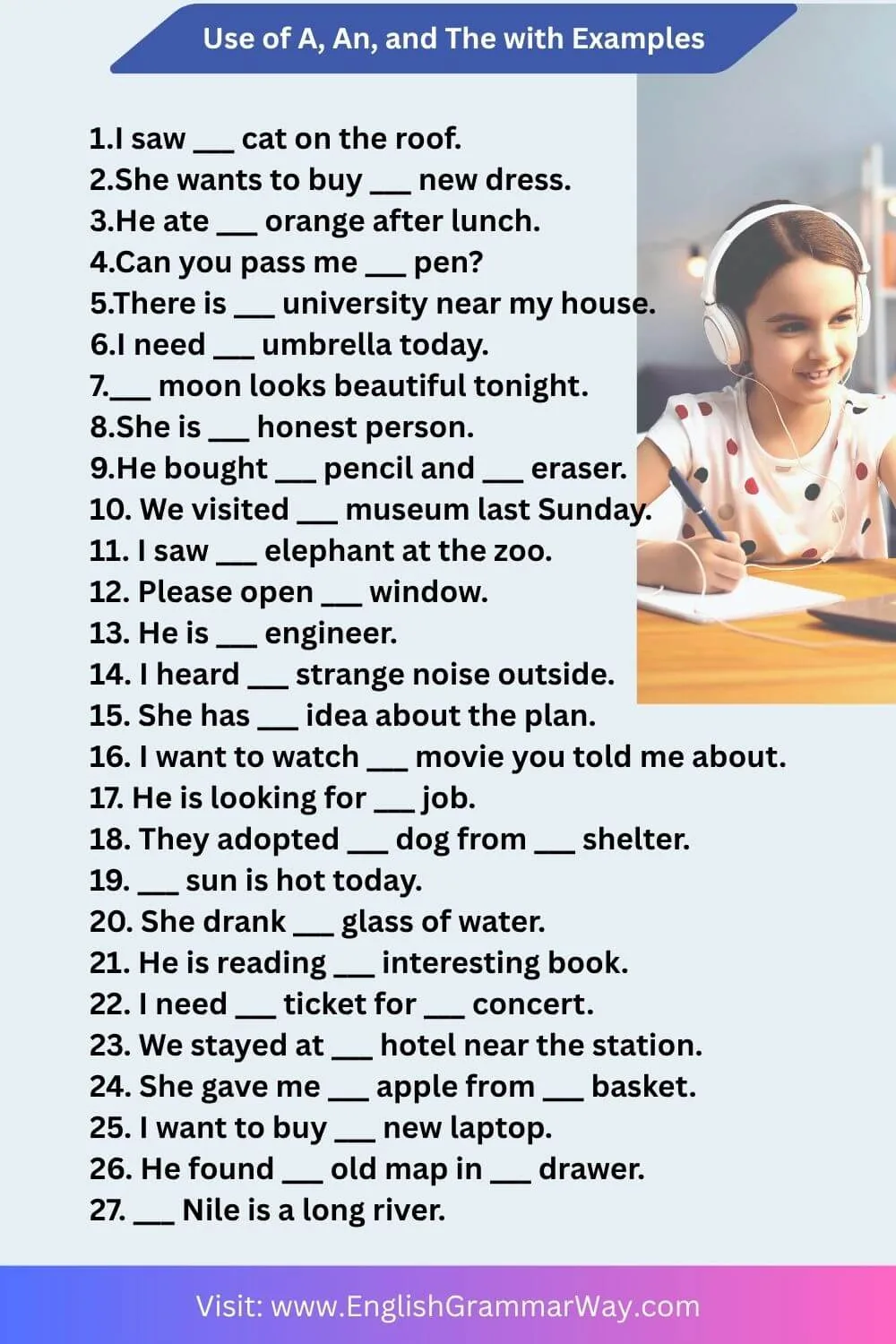
Answer: 1. a 2. a 3. an 4. the 5. a 6. an 7. the 8. an 9. a, an 10. the 11. an 12. the 13. an 14. a 15. an 16. the 17. a 18. a, the 19. the 20. a 21. an 22. a, the 23. a 24. an, the 25. a 26. an, the 27. the
Quick Recap of Article Rules
Understanding articles can be confusing at first, but this recap will make it easier to remember. Articles are small words that help clarify whether we are talking about something specific or general.
Here’s a detailed summary
| Type | Article | Usage Example | Explanation |
| Indefinite | a | a car, a book, a teacher | Used before singular, countable nouns when referring to any one item, not a specific one. The listener doesn’t know exactly which item you mean. |
| Indefinite | an | an apple, an hour, an idea | Same as “a,” but used before words that start with a vowel sound. Remember, it’s the sound that matters, not just the first letter. |
| Definite | the | the sun, the earth, the book | Used when referring to something specific, known, or unique. Both the speaker and listener know which noun is being discussed. |
Important Notes and Tips
- First vs. Second Mention
- Use a/an when introducing something for the first time.
Example: I saw a dog in the park. - Use the when mentioning it again, because it is now specific.
Example: The dog was barking loudly.
- Use a/an when introducing something for the first time.
- General vs. Specific
- a/an = general: I need a pen (any pen will do).
- the = specific: I need the pen on your desk (a particular pen).
- Uncountable and Plural Nouns
- When talking in general, do not use an article.
Example:- ❌ I like a water → ✅ I like water.
- ❌ I saw a cats → ✅ I saw cats.
- Use the when referring to specific uncountable or plural nouns.
Example: The water in this bottle is cold.
Example: The cats in my neighborhood are friendly.
- When talking in general, do not use an article.
- Special Cases
- a before consonant sounds, an before vowel sounds (sound matters more than the letter).
Example: a university (consonant “yu” sound), an hour (silent “h”). - The with unique nouns, famous places, rivers, oceans, superlatives, and groups of people.
Example: The Himalayas, The Pacific Ocean, The president, The rich.
- a before consonant sounds, an before vowel sounds (sound matters more than the letter).
- Job Titles
- Use a/an when referring to someone’s profession:
She is a doctor.
He is an engineer. - Do not use the unless you are talking about a specific person in that role:
The doctor you met yesterday is very kind.
- Use a/an when referring to someone’s profession:
- Practice Examples for Quick Memory
- First mention: I saw a cat in the garden.
- Second mention: The cat was chasing a butterfly.
- Vowel sound: I ate an orange.
- Consonant sound: He bought a chair.
- Unique object: Look at the moon.
- General idea: I love music.
- Plural noun general: Dogs are loyal animals.
- Plural noun specific: The dogs in our street are playful.
Key Takeaways
- a/an = general, singular, countable nouns.
- the = specific, known, unique, or previously mentioned nouns.
- No article = general, plural, or uncountable nouns.
- Sound rules matter for choosing a an.
- Special nouns like rivers, mountains, oceans, superlatives, and famous buildings usually need the.
Summary
In English grammar, articles play a vital role in sentence clarity and correctness. They help us express whether something is known or unknown, specific or general. Mastering article rules – especially articles a, an, the rules – makes your writing smoother and more accurate.
By understanding the examples of articles and practising them in daily conversation, you can greatly improve your English fluency.
Remember: use a and an for general things, and the for specific ones.